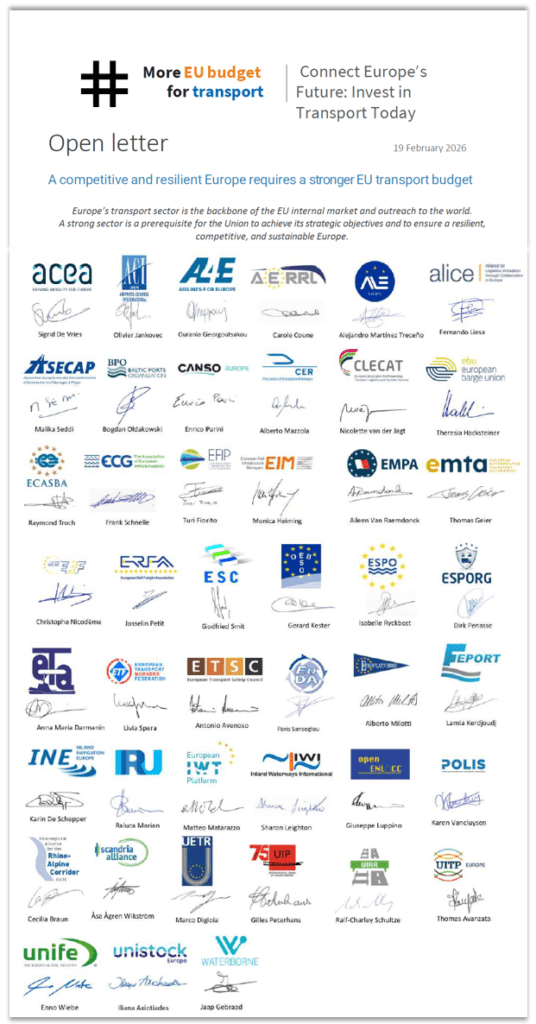
Open letter: A competitive and resilient Europe requires a stronger EU transport budget
Europe’s transport sector is the backbone of the EU internal market and outreach to the world. A strong sector is a prerequisite for the Union to achieve its strategic objectives and to ensure a resilient, competitive, and sustainable Europe.
Europe’s transport sector strongly urges the EU Member States to strengthen European funding for transport under the future EU budget. A robust European transport network is of crucial importance in responding to Europe’s strategic objectives, making adequate European support to the sector more pertinent than ever. Only with strong and state-of-the-art transport infrastructure at its core, will Europe be able to ramp up its resilience and military preparedness, reinforce its industrial competitiveness and safeguard its supply chain sovereignty. All the signatory European transport organisations urgently call upon the EU Member States and the EU Commission to ensure sufficient EU budget for transport under the future Multi-Annual Financial Framework and particularly to increase the budget of the future Connecting Europe Facility (CEF) to at least €100 billion.
With rising geopolitical and geo-economic tensions as well as ongoing climate change, it must be Europe’s top priority to strengthen and ensure a well-integrated and interconnected European transport network in order to be able to effectively respond to these challenges. We must act now to strengthen and update Europe’s infrastructure, address bottlenecks and missing links, optimise its connectivity and capacity, and reinforce its safety, resilience and preparedness for climate change adaptations, taking into account the TEN-T guidelines and all its building blocks. In fact, the recently proposed Military Mobility Regulation underlines that while military mobility is vital for Europe’s security and defence, EU transport infrastructure is insufficiently adapted to dual-use needs and remains vulnerable to both natural and man-made disruptions. Moreover, the current geopolitical landscape highlights the need to prepare for justin- case on top of the just-in-time strategies, requiring redundancy and buffer capacity to ensure the continuation of the supply of goods and the movement of people to the benefit of Europe’s economy and society. Hence, there is a pressing need to address these infrastructure hurdles and improve and invest in Europe’s infrastructure readiness, protection and resilience accordingly.
Transport is the backbone, enabler and accelerator of the EU internal market. If Europe wants to boost its industrial competitiveness and become a leader in the shift to a net-zero economy, it needs to provide an efficient transport network to effectively link the current and new production sites with their markets. A strong and competitive sector is needed to ensure Europe’s economic, social and territorial cohesion, ensure its supply of critical raw materials, and safeguard its supply chain sovereignty. This all depends on the reliability of the infrastructure network, as witnessed by the recent reports by Mario Draghi and Enrico Letta, underscoring how a well-functioning European transport network is essential to drive economic growth, job creation and social and regional cohesion.
While the ambitions and the investment needs are high, the sector continues to struggle with pressing underfunding and financing gaps. Transport projects with high societal added-value do not always generate the necessary financial returns to cover the investments. EU grants are necessary to support those projects that are crucial to achieve Europe’s strategic objectives but may face significant funding gaps. Grants also act as a catalyst to attract further private sector and national funding. The Connecting Europe Facility has proven as a crucial and highly successful instrument to support and prioritise investments of high European added value, yet has been undermined by a structural and significant oversubscription of the calls in light of insufficient budget. Our sector stands ready to deliver, but cannot do so without adequate support.
The organisations representing Europe’s transport sector therefore urge the Member States and the Commission to reverse this trend of continued underfunding of the transport sector and set the bar high. If Europe is to succeed in its strategic priorities of a strong, resilient and competitive Union, it needs a robust European transport network providing the necessary fundament. This must be reflected in the future Multi-Annual Financial Framework, safeguarding sufficient EU budget for transport and a CEF instrument that is supported with a budget of at least €100 billion.
Read the full letter here